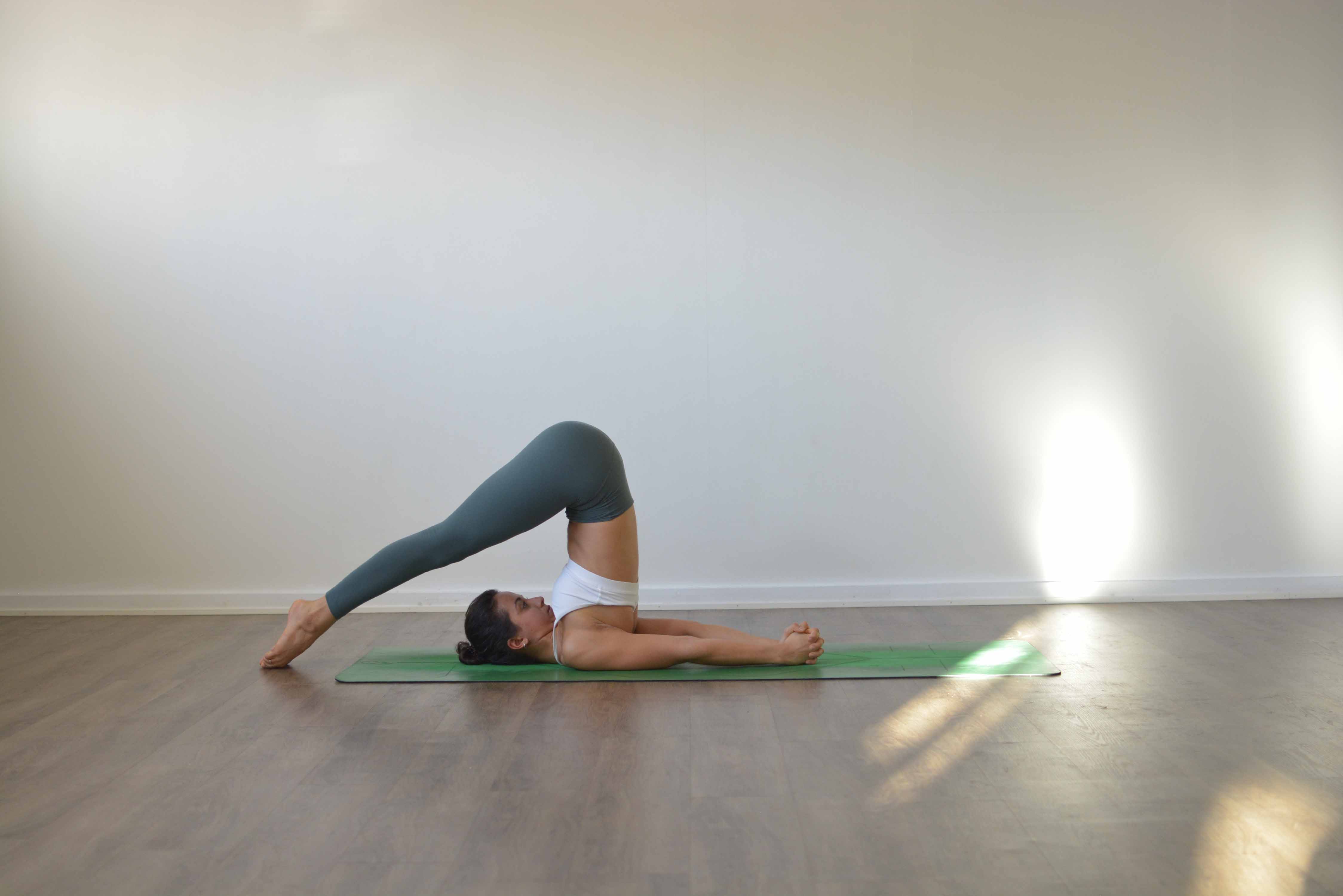
The Art of the Plough: A Comprehensive Guide to Halasana
Halasana, or the Plough Pose, is often called the “Mother of Yoga Asanas” for its ability to nurture the entire internal system. In a world where we spend most of our time upright or slumped forward, Halasana offers a radical reversal. It doesn’t just stretch the back; it flips your perspective, flushes your organs, and resets your nervous system.
Below is an exploration of why this pose is essential, how to do it safely, and the specific benefits that make it a cornerstone of a longevity-focused yoga practice.
Step-by-Step Instructions
Before starting, ensure you have a firm, flat surface. If you have a sensitive neck, place a folded yoga blanket under your shoulders (but not your head) to create a protective “shelf” for your cervical spine.
1. The Starting Position
Lie flat on your back in a supine position. Place your arms by your sides with your palms facing down. Relax your jaw and soften your gaze.
2. The Lift (Half Plough)
On an inhale, use your abdominal strength to lift your legs to a 90-degree angle. Keep your legs active and your feet flexed.
3. Transitioning to the Inversion
Exhale and press your palms into the floor. Use your core to lift your hips off the mat, curling your spine until your feet travel over your head.
4. The Landing
Slowly lower your toes toward the floor behind your head.
- If your feet touch the floor: You can release your hands from your back and interlace your fingers on the mat, stretching your arms away from your torso.
- If your feet do NOT touch the floor: Keep your hands firmly on your lower back for support. Never let your feet hang in mid-air without hand support, as this puts undue pressure on the neck.
5. Holding the Pose
Stay in the pose for 30 seconds to 1 minute. Breathe deeply into the back of your ribcage. Keep your neck still—never turn your head to the side while in this position.
6. The Exit
To release, bring your hands back to the floor for brakes. Slowly roll your spine down, vertebra by vertebra, until your back and legs are flat on the mat.
Proper Execution: Safety Over Ego
To reap these benefits without injury, alignment is non-negotiable.
- Foundation: Lie supine. If you have any neck sensitivity, place a folded blanket under your shoulders to ensure your neck isn’t flattened against the mat.
- The Ascent: Engage your core. Using your deep abdominal muscles, lift your legs to 90 degrees, then continue the arc until your hips lift and your feet travel toward the floor behind your head.
- The Landing: If your feet don’t touch the floor, keep your hands on your lower back for support. If they do touch, you can interlace your fingers on the mat and press your pinky edges down to lift your torso higher.
- The Gaze: Keep your eyes fixed on your navel or the ceiling. Never turn your head in this pose, as the cervical spine is under significant load.
Modifications for Every Body
You do not need to be a contortionist to experience the benefits of the Plough.
- The “Half-Plough”: If your hamstrings are tight, rest your feet on a chair or a stack of blocks behind your head. This provides all the digestive and endocrine benefits without straining the lower back.
- The Bolster Support: Placing a bolster under the hips can help those with restricted mobility ease into the inversion safely.
The Hidden Benefits: Why We Practice Halasana
The beauty of Halasana lies in its “compound” nature—it works on multiple systems of the body simultaneously.
1. Metabolic & Endocrine Regulation
When you tuck your chin toward your chest in the “Chin Lock” (Jalandhara Bandha), you are applying gentle pressure to the thyroid and parathyroid glands.
- The Result: This helps regulate the metabolic rate, manage body weight, and balance calcium levels in the blood. When you release the pose, a fresh surge of oxygenated blood flushes these glands, revitalizing their function.
2. Spinal Decompression and Posture Correction
Modern life creates “anterior dominance”—we are always reaching forward. Halasana provides a deep, passive stretch to the posterior chain.
- The Result: It creates space between the vertebrae, particularly in the thoracic and lumbar regions. Regular practice can alleviate chronic lower back pain and counteract the rounded shoulders associated with “tech-neck.”
3. “Visceral Massage” for Digestion
The folding action of the torso compresses the abdominal organs.
- The Result: This acts as a manual massage for the liver, spleen, and intestines. It is famously effective for relieving constipation and trapped gas, essentially “squeezing out” toxins and encouraging peristalsis.
4. Nervous System “Cooling”
As an inversion, Halasana encourages blood flow toward the brain.
- The Result: It triggers the parasympathetic nervous system (the “Rest and Digest” mode). Many practitioners find that holding a supported Halasana for 3–5 minutes reduces mental fatigue, calms anxiety, and prepares the body for deep sleep.
Proper Execution: Safety Over Ego
To reap these benefits without injury, alignment is non-negotiable.
- Foundation: Lie supine. If you have any neck sensitivity, place a folded blanket under your shoulders to ensure your neck isn’t flattened against the mat.
- The Ascent: Engage your core. Using your deep abdominal muscles, lift your legs to 90 degrees, then continue the arc until your hips lift and your feet travel toward the floor behind your head.
- The Landing: If your feet don’t touch the floor, keep your hands on your lower back for support. If they do touch, you can interlace your fingers on the mat and press your pinky edges down to lift your torso higher.
- The Gaze: Keep your eyes fixed on your navel or the ceiling. Never turn your head in this pose, as the cervical spine is under significant load.
Modifications for Every Body
You do not need to be a contortionist to experience the benefits of the Plough.
- The “Half-Plough”: If your hamstrings are tight, rest your feet on a chair or a stack of blocks behind your head. This provides all the digestive and endocrine benefits without straining the lower back.
- The Bolster Support: Placing a bolster under the hips can help those with restricted mobility ease into the inversion safely.
-
Is it normal to feel like I can’t breathe well in Halasana?
Because the chin is tucked toward the chest (the Jalandhara Bandha), the airway is slightly constricted and the diaphragm is compressed by the abdominal organs. Focus on intercostal breathing—expanding the breath into the back and sides of your ribcage rather than the belly. If the breath becomes gasping or impossible, exit the pose immediately.
-
Why can’t my feet touch the floor behind my head?
A: This is usually due to tightness in the hamstrings or the fascia along the spine. If your feet are hovering, do not force them down, as this can strain your lower back. Instead, place a chair or a stack of yoga blocks behind your head to rest your feet on. This allows you to reap the benefits of the inversion while staying within your body’s current limits.
-
How long should I hold the pose to see results?
For beginners, 30 to 60 seconds is sufficient to stimulate the nervous system. Advanced practitioners may hold it for 3–5 minutes to achieve a deep “meditative” state. However, the quality of your alignment is always more important than the duration.
-
Can Halasana help with weight loss?
Indirectly, yes. By stimulating the thyroid gland, Halasana helps balance the metabolism. It also improves digestion and reduces cortisol (the stress hormone), which is often linked to abdominal fat storage. It is best used as a metabolic “toner” within a complete fitness routine.
-
Should I do Halasana if I have a neck injury?
Generally, no. Halasana puts significant weight on the cervical spine. If you have a history of herniated discs, chronic neck pain, or spondylitis, you should skip this pose and opt for a gentler inversion like Viparita Karani (Legs-Up-The-Wall pose).
-
My back feels “crunchy” or stiff when I come out of the pose. What am I doing wrong?
You might be “collapsing” out of the pose too quickly. The exit is just as important as the entry. Use your arms as brakes and roll down one vertebra at a time. Immediately following up with Matsyasana (Fish Pose) will help neutralize that stiffness by stretching the spine in the opposite direction.